📕 Steal Like a Human
About a week ago we drove to the Oregon coast. We spent a little time in Manzanita, and while we were there we stopped by a charming little bookstore called Cloud & Leaf. Nothing initially caught my eye, but on the way out I noticed a 10th anniversary edition of Steal Like an Artist by Austin Kleon. I've always wanted to read it, so I picked it up.
Tonight I sat down and read it cover to cover (that's not a boast; it's a short book that's easy to get through in a single sitting). It's quite good, and I recommend it.
The book was originally published in 2012, and 14 years later it's anything but out of date. There are some offhand references to how the Internet worked back then which no longer bear any resemblance to reality, but it's nothing that detracts from the material in any way (although a mention of Google Reader made me pine a little for a particular time online that will never come again).
Many of the thoughts and ideas in the book weren't new to me, and likely wouldn't be new to you, but it's nice to have them so succulently and expertly packaged into a single, handy tome. The book serves as a good reminder of the ingredients required for a solid creative foundation. It's stuff I needed to hear—stuff I needed to be reminded of—and I imagine the same is probably true for you as well.
Looking at things through the lens of our present moment, one thing in particular caught my eye:
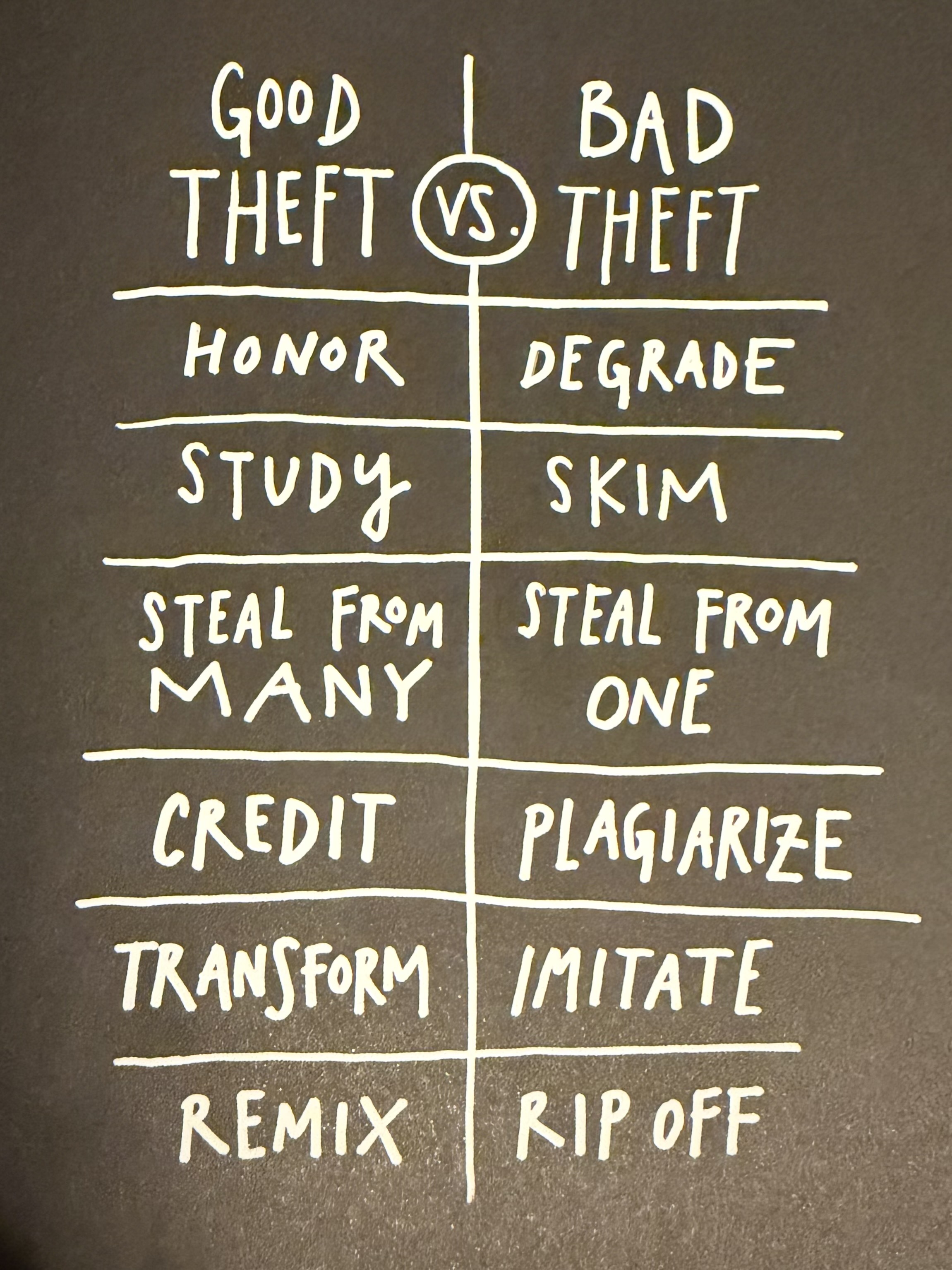
It sure is interesting that generative AI decided to take all but one of the things from the "bad theft" column and only one from the "good theft" column.
A few pages before that, Austin writes:
What to copy is a little bit trickier. Don't just steal the style, steal the thinking behind the style. You don't want to look like your heroes, you want to see like your heroes.
The reason to copy your heroes and their style is so that you might somehow get a glimpse into their minds. That's what you really want—to internalize their way of looking at the world. If you just mimic the surface of somebody's work without understanding where they are coming from, your work will never be anything more than a knockoff.
Today the effort required to mimic the surface of others' work is close to zero. The flood of knockoffs is unprecedented. So much is so shallow. The seemingly-pervasive disregard so many people have for ethics, honor, and credit is suffocating and disheartening (to say nothing of the other small, tiny, inconsequential issues like, say, the environment and massive consolidation of power).
Despite all that, this book reminded me that the journey—our personal creative journey—is replete with rewards that will never be realized if we take shortcuts. I knew that before I read this, in both my head and my heart, but having a physical artifact harmonize with those thoughts and feelings is comforting and delightful.
This is a tough time, but there's hope. The only way out is through.